
Artificial Intelligence (AI) is everywhere in 2026. In this Types of Artificial Intelligence guide, we explore how different categories of AI power the technology we use every day. Whether you’re asking ChatGPT a question, getting movie recommendations on Netflix, shopping on Amazon, or using Google Maps to find the fastest route home, AI is working behind the scenes.
But here’s something many people don’t know:
Not all AI is the same.
Some AI can only perform one specific task. Some AI can learn from past experiences. Other types of AI exist only in research labs or science fiction movies.
Understanding the different types of AI helps you know what today’s AI can do—and what future AI might be capable of.
In this beginner-friendly guide, you’ll learn:
- What artificial intelligence is
- Why AI is divided into different types
- The four main types of AI based on capability
- Real-world examples of each type
- Which types of AI already exist
- Which ones are still being developed
Let’s get started.
Table of Content
- What Is Artificial Intelligence?
- Why Are There Different Types of AI?
- The Four Main Types of Artificial Intelligence
- Types of AI Based on Functionality
- Comparison Table: Types of AI
- ANI vs AGI vs ASI
- Why Understanding AI Types Matters
- Final Thoughts
What Is Artificial Intelligence?
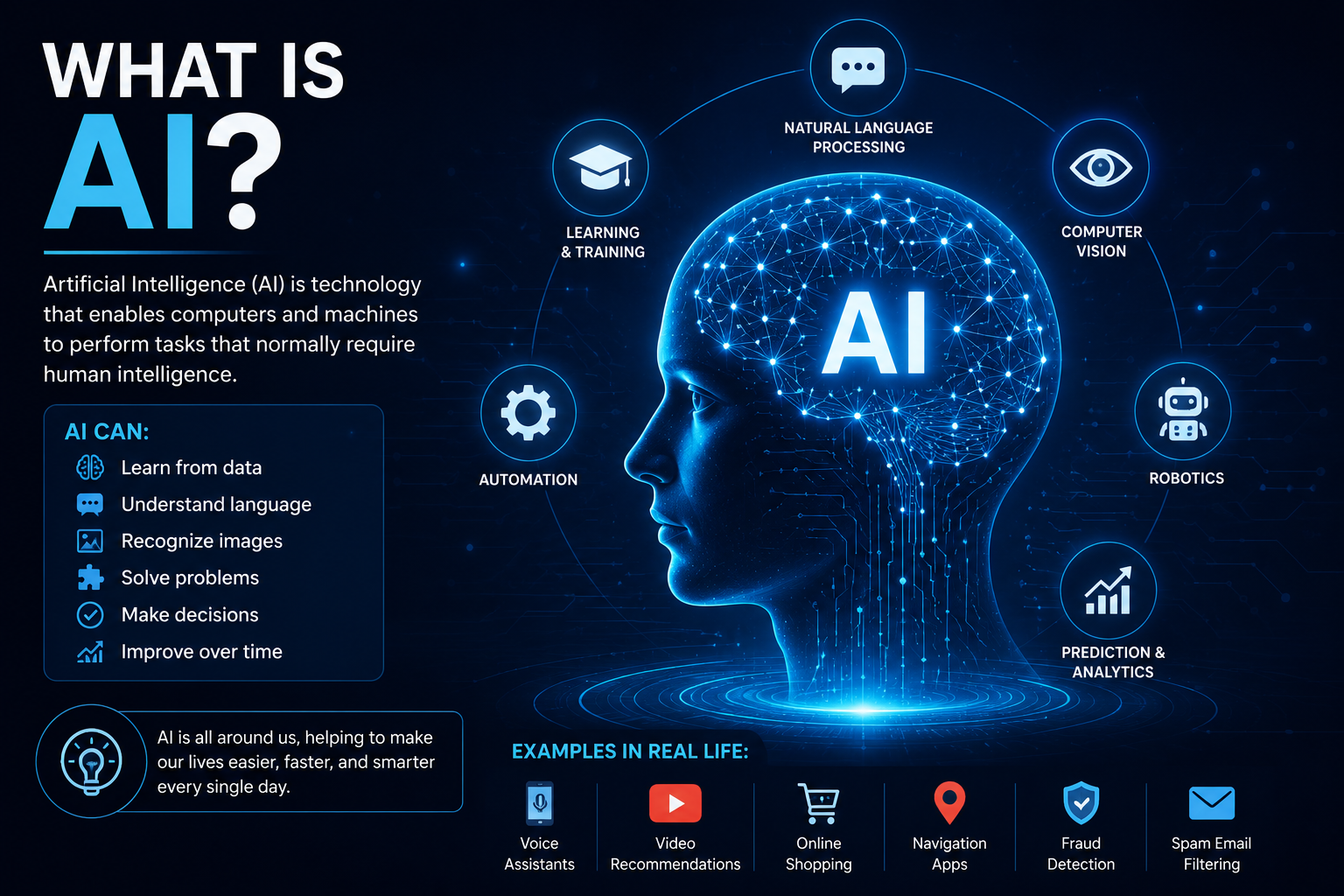
Artificial Intelligence is technology that allows computers and machines to perform tasks that normally require human intelligence.
These tasks include:
- Understanding language
- Recognizing images
- Learning from information
- Solving problems
- Making predictions
- Answering questions
- Creating text, images, music, and videos
Unlike traditional software that follows fixed instructions, many AI systems improve by learning from large amounts of data.
For example:
When you ask ChatGPT a question, it doesn’t search for one saved answer. Instead, it predicts the most helpful response based on patterns learned during training.
Why Are There Different Types of AI?
Not every AI system has the same abilities.
Think about vehicles.
A bicycle, a car, and an airplane all help people travel, but they work in very different ways.
AI is similar.
Some AI can only do one job.
Others can perform many related tasks.
Scientists also study future AI that may think more like humans.
To better understand these differences, researchers divide AI into several categories.
The most common way is by capability, meaning what the AI is able to do.
The Four Main Types of Artificial Intelligence
Based on capability, AI is usually divided into four categories:
- Reactive Machines
- Limited Memory AI
- Theory of Mind AI
- Self-Aware AI
Let’s look at each one.
1. Reactive Machines
Reactive Machines are the simplest types of artificial intelligence.
It does not remember previous events.
They cannot learn from experience.
They only react to the information they receive at the current moment.
Imagine a calculator.
Every time you type:
25 + 30
It always gives the same answer.
It doesn’t remember what you calculated yesterday.
Reactive AI works in a similar way.
It analyzes the current situation and immediately makes a decision.
How Reactive AI Works
Reactive AI follows these basic steps:
- Receives information
- Analyzes the current situation
- Chooses the best response
- Produces an output
Once the task is finished, it forgets everything.
Real-Life Examples of Reactive AI
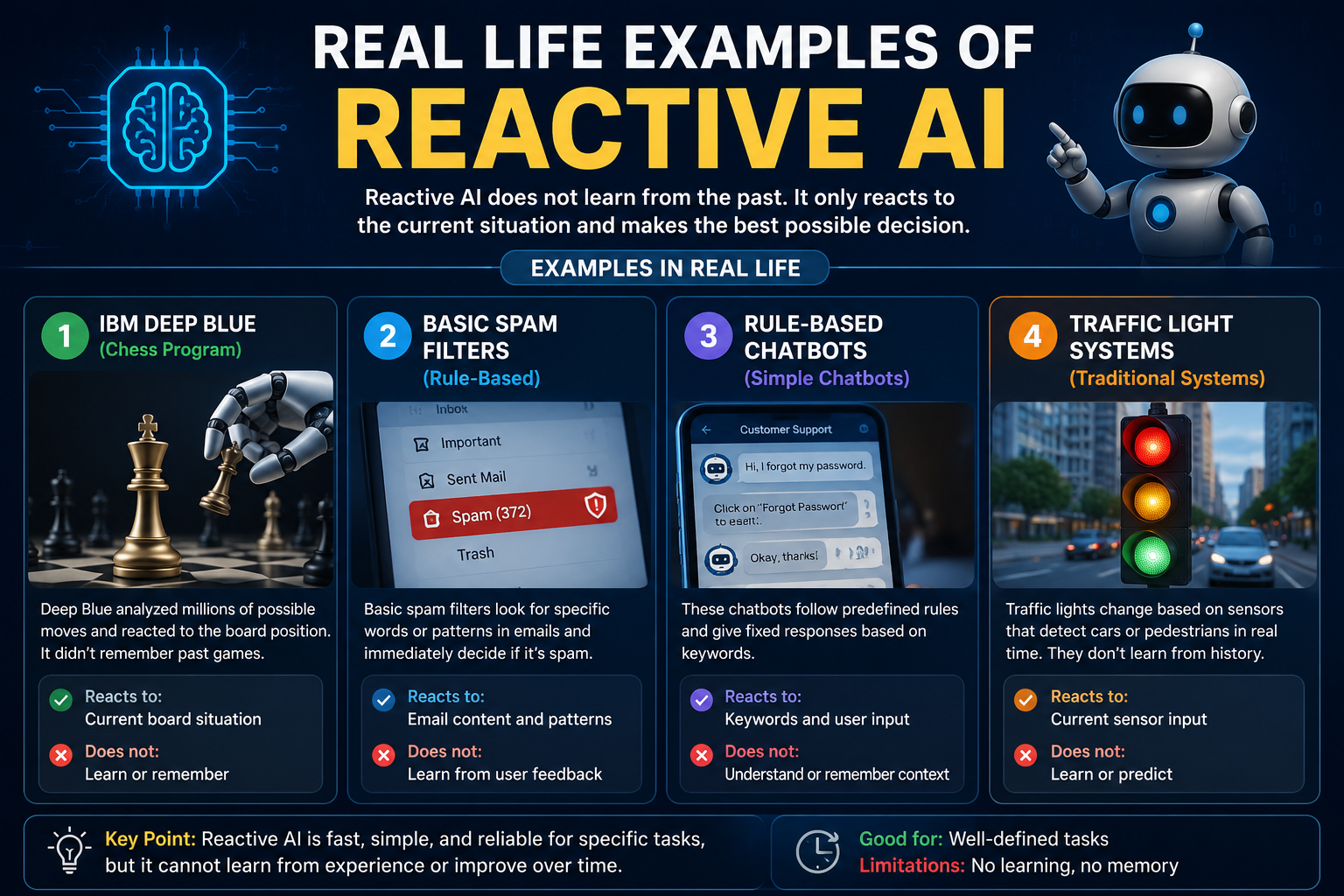
Chess Programs
One of the most famous examples is IBM’s Deep Blue.
Deep Blue defeated world chess champion Garry Kasparov in 1997.
It didn’t remember previous games like a human player.
Instead, it analyzed millions of possible moves during each turn before selecting the best one.
Spam Email Filters (Basic Versions)
Some simple spam filters check an incoming email for certain words or patterns.
If the email matches those patterns, it is marked as spam.
The filter reacts only to what it sees at that moment.
Rule-Based Chatbots
Many customer service chatbots on websites use reactive AI.
For example:
Customer:
“I forgot my password.”
Bot:
“Click ‘Forgot Password’ to reset it.”
The chatbot follows predefined rules rather than remembering previous conversations.
Advantages of Reactive AI
Reactive AI has several benefits:
- Fast responses
- Easy to build
- Reliable for specific tasks
- Predictable behavior
- Requires less computing power
Limitations of Reactive AI
However, Reactive AI has important limitations.
It cannot:
- Learn from experience
- Remember previous interactions
- Improve over time
- Understand long conversations
- Make complex decisions using past information
Because of these limits, most modern AI systems have moved beyond reactive behavior.
2. Limited Memory AI
Limited Memory AI is the type of artificial intelligence used most often today.
Unlike Reactive Machines, Limited Memory AI can remember past information for a short period.
It uses that information to make better decisions.
Most AI tools you use every day belong to this category.
How Limited Memory AI Works
Limited Memory AI follows a process like this:
- Collects information
- Stores recent data
- Learns from patterns
- Makes predictions
- Improves future decisions
Although it remembers previous information, it doesn’t remember everything forever.
Some information is kept only temporarily.
Other information is used during training to improve the AI model.
Examples of Limited Memory AI
ChatGPT
ChatGPT is one of the best-known examples of Limited Memory AI.
It can remember earlier messages within the same conversation.
For example:
You tell ChatGPT:
“My favorite sport is basketball.”
Later you ask:
“What shoes should I buy?”
ChatGPT understands that you’re probably asking about basketball shoes.
That short-term memory helps create more useful responses.
However, the model doesn’t permanently remember every conversation unless specific memory features are enabled.
Self-Driving Cars
Self-driving vehicles constantly observe their surroundings.
They monitor:
- Other cars
- Pedestrians
- Road signs
- Traffic lights
- Lane markings
- Speed limits
The AI remembers recent information for several seconds while making driving decisions.
For example:
If another car suddenly brakes, the AI remembers that movement and reacts accordingly.
Without this short-term memory, safe driving would be impossible.
Recommendation Systems
Many online services recommend products or videos using Limited Memory AI.
Examples include:
- Netflix recommendations
- Amazon product suggestions
- Spotify playlists
- YouTube video recommendations
The AI looks at:
- What you’ve watched
- What you’ve purchased
- What you’ve searched
- What you’ve liked
It then predicts what you may enjoy next.
The more data available, the better the recommendations usually become.
Voice Assistants
Voice assistants like Siri, Google Assistant, and Alexa also use Limited Memory AI.
If you ask:
“What’s the weather today?”
Then immediately ask:
“What about tomorrow?”
The assistant understands you’re still talking about the weather.
That understanding comes from remembering recent context.
AI Image Generators
Popular AI image generators can also be considered Limited Memory AI.
They use patterns learned from enormous datasets to create new images from text prompts.
For example:
“A golden retriever surfing at sunset.”
The AI combines everything it learned during training to generate an original image.
Why Limited Memory AI Is So Important
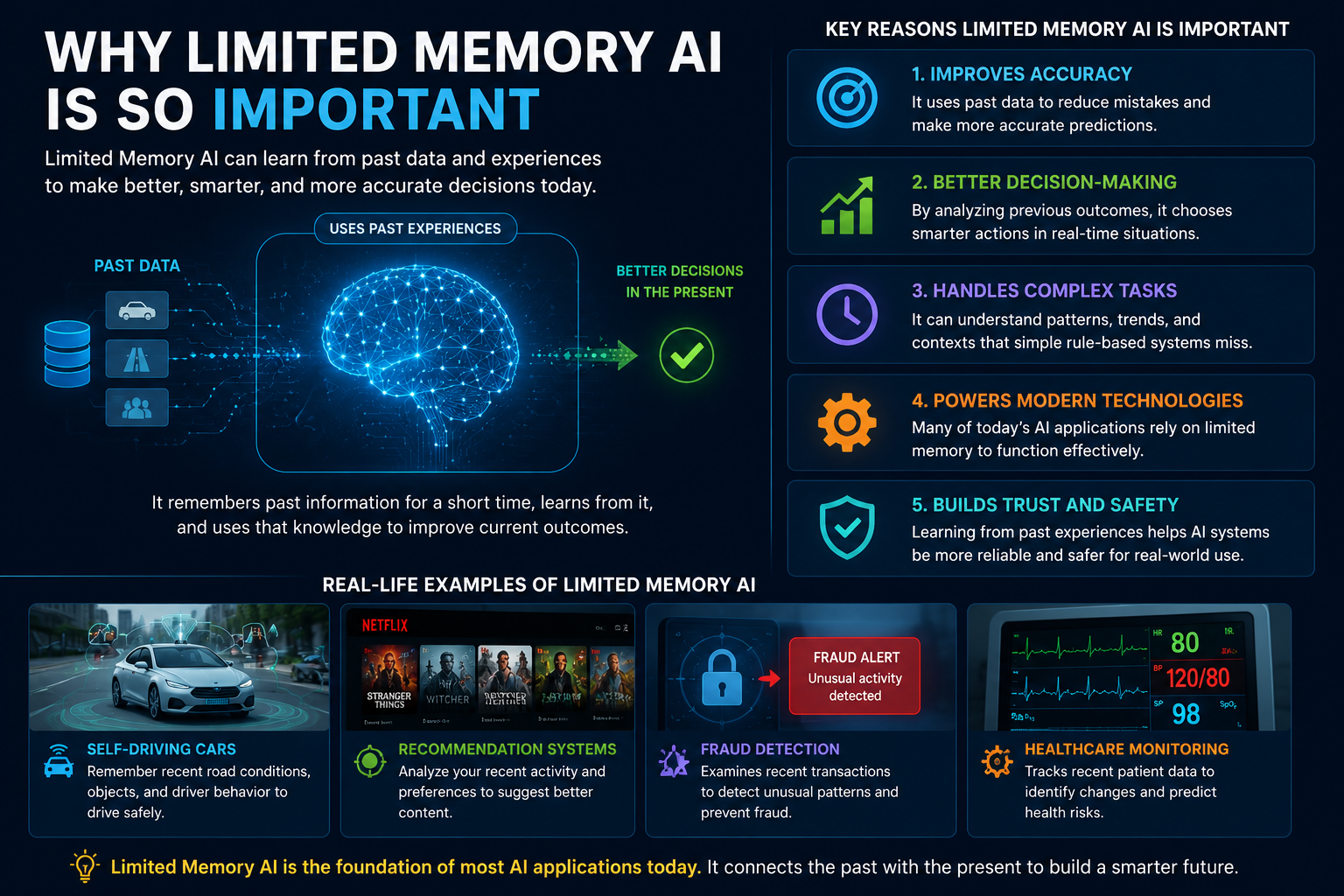
Nearly every major AI breakthrough today depends on Limited Memory.
Without it, AI couldn’t:
- Understand conversations
- Drive vehicles
- Detect fraud
- Recommend movies
- Translate languages
- Recognize speech
- Create images
- Generate text
- Predict customer behavior
This is why Limited Memory AI powers many of the world’s most popular AI applications.
Industries Using Limited Memory AI
Many industries now rely on this type of AI.
Healthcare
Doctors use AI to help identify diseases from medical images and patient data.
The AI compares current scans with patterns learned from previous cases.
Finance
Banks use AI to detect unusual transactions that may indicate fraud.
The system compares current activity with previous spending patterns.
Retail
Online stores analyze shopping habits to recommend products customers are likely to purchase.
Education
Learning platforms personalize lessons based on a student’s progress.
If a learner struggles with multiplication, the AI may recommend additional practice before moving on.
Entertainment
Streaming services study viewing history to recommend TV shows and movies that match individual interests.
3. Theory of Mind AI
Theory of Mind AI is the third type of artificial intelligence based on capability.
Unlike today’s AI, this type would be able to understand that people have their own thoughts, emotions, beliefs, and intentions.
In simple words, it wouldn’t just understand what you say—it would also try to understand why you said it and how you feel.
Humans do this naturally every day.
For example, if your friend says, “I’m fine,” but looks upset, you might realize they’re actually feeling sad.
Current AI systems cannot truly understand emotions in this human sense. They can recognize patterns in text, voice, or facial expressions, but they do not experience feelings or genuinely understand them.
How Theory of Mind AI Would Work
If this type of AI is developed in the future, it could:
- Understand emotions
- Recognize intentions
- Predict how people might react
- Adapt conversations based on someone’s feelings
- Improve teamwork between humans and AI
This would make AI much more natural to interact with.
Possible Future Uses
Researchers believe Theory of Mind AI could someday help in areas such as:
Healthcare
AI assistants might better understand a patient’s emotional state and support healthcare professionals by recognizing signs of stress or anxiety.
Education
AI tutors could adjust lessons based on whether a student appears confused, frustrated, or confident.
Customer Service
Virtual assistants could respond more naturally to frustrated customers and adjust their tone appropriately.
Robotics
Household or workplace robots might better understand human behavior and cooperate more effectively with people.
Does Theory of Mind AI Exist Today?
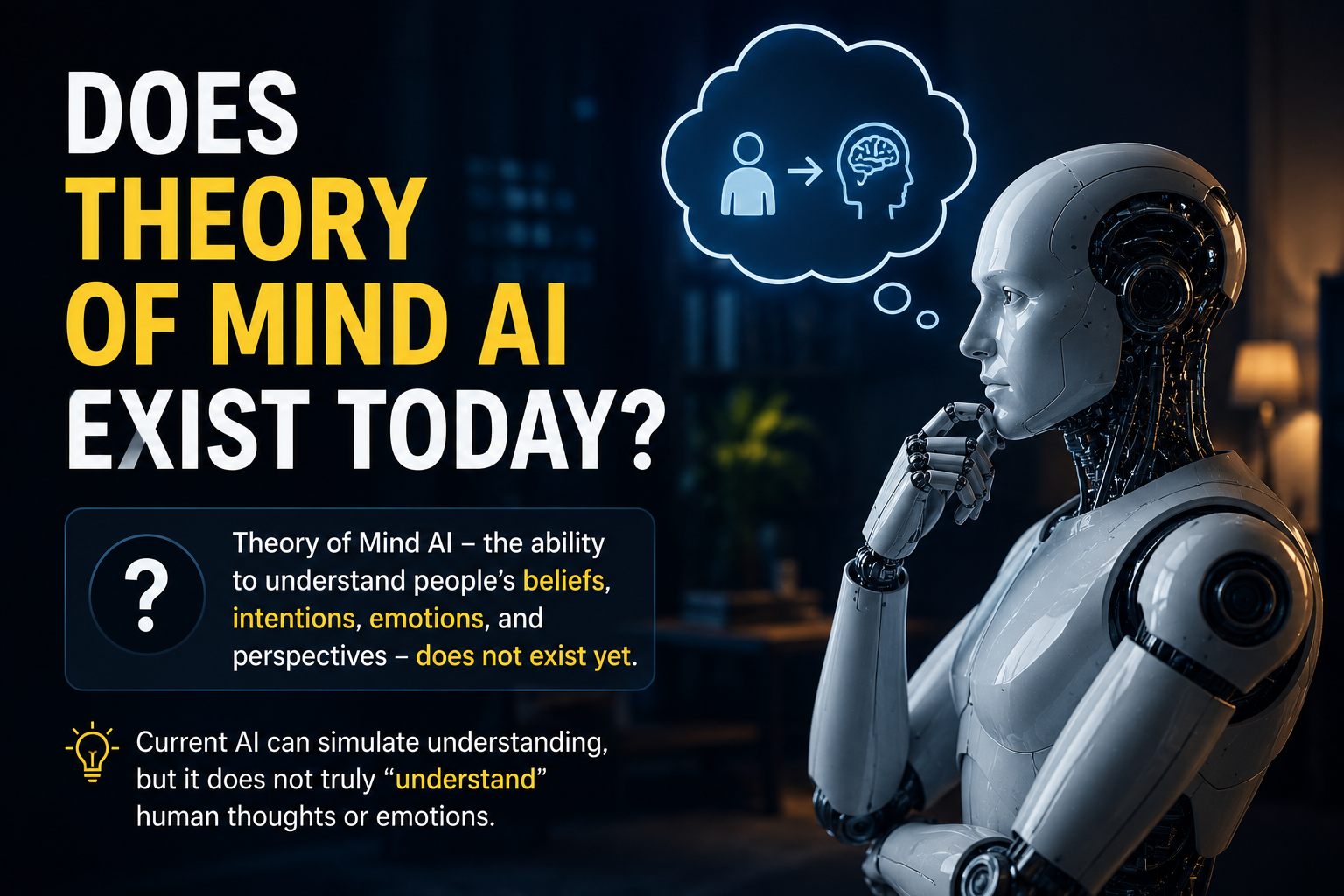
No.
Researchers are actively studying emotional intelligence and human-AI interaction, but there is currently no AI system that truly understands human emotions or thoughts the way people do.
Some AI tools can detect emotional cues from speech, writing, or facial expressions, but that is very different from genuinely understanding emotions.
For now, Theory of Mind AI remains a research goal rather than a reality.
4. Self-Aware AI
Self-Aware AI is the fourth and most advanced category of artificial intelligence.
This type of AI exists only as a theoretical concept.
It would not only understand other people but also have awareness of itself.
A self-aware AI would theoretically know:
- That it exists
- Its own goals
- Its own internal state
- Its surroundings
- Its actions
This idea often appears in science fiction movies and books.
However, no existing AI system has these abilities.
Could Self-Aware AI Exist?
No one knows.
Scientists, engineers, and philosophers continue to debate whether machines could ever become conscious.
There is currently no scientific evidence that today’s AI systems are becoming self-aware.
Modern AI generates responses by recognizing patterns in data. It does not possess consciousness, emotions, beliefs, or personal experiences.
Challenges of Self-Aware AI
If self-aware AI were ever created, it would raise many important questions.
For example:
- How should it be used?
- Who would be responsible for its decisions?
- How could it be kept safe?
- What rules should governments create?
These are topics researchers continue to discuss.
Types of Artificial Intelligence Based on Functionality
Another common way to classify artificial intelligence is by functionality, or what kind of intelligence it has.
There are three main categories:
- Artificial Narrow Intelligence (ANI)
- Artificial General Intelligence (AGI)
- Artificial Superintelligence (ASI)
Artificial Narrow Intelligence (ANI)
Artificial Narrow Intelligence, also called Weak AI, is the only type of AI that currently exists.
ANI is designed to perform specific tasks.
It cannot do everything a human can.
Instead, it focuses on one area or a small group of related tasks.
For example:
- Writing text
- Translating languages
- Recommending movies
- Recognizing faces
- Playing chess
- Creating images
- Detecting spam emails
Although ANI can perform some tasks extremely well, it cannot think independently or apply its knowledge to completely unrelated problems.
Examples of ANI
Many popular AI tools are examples of Artificial Narrow Intelligence, including:
- ChatGPT
- Google Search AI features
- Google Translate
- Siri
- Alexa
- Netflix recommendation system
- Spotify recommendations
- AI image generators
- Fraud detection systems
Each system is designed for a particular purpose.
Artificial General Intelligence (AGI)
Artificial General Intelligence is often called Strong AI.
AGI would be able to perform nearly any intellectual task that a human can do.
Unlike ANI, AGI could:
- Learn new skills without extensive retraining
- Solve unfamiliar problems
- Apply knowledge across different subjects
- Reason more broadly
- Adapt to new situations
For example, an AGI might:
- Write a book
- Learn medicine
- Design a building
- Teach mathematics
- Cook dinner
- Learn a new language
—all without being specially built for each individual task.
Does AGI Exist?
No.
Researchers around the world are working toward more capable AI systems, but no verified Artificial General Intelligence currently exists.
Today’s AI models are powerful, but they remain specialized systems rather than human-level general intelligence.
Artificial Superintelligence (ASI)
Artificial Superintelligence refers to a hypothetical AI that would exceed human intelligence across virtually every field.
In theory, ASI could outperform humans in areas such as:
- Scientific research
- Mathematics
- Engineering
- Medical discoveries
- Business strategy
- Creativity
- Problem-solving
However, this idea remains speculative.
No Artificial Superintelligence exists today.
Whether it can ever be created is unknown.
Comparison Table: Types of Artificial Intelligence
| Type | Exists Today? | Can Learn? | Memory | Examples |
|---|---|---|---|---|
| Reactive Machines | Yes | No | No | IBM Deep Blue |
| Limited Memory AI | Yes | Yes | Short-term or training-based | ChatGPT, self-driving technology, recommendation systems |
| Theory of Mind AI | No | Theoretical | Would understand emotions | None |
| Self-Aware AI | No | Theoretical | Self-awareness | None |
ANI vs AGI vs ASI
| Type | Current Status | Intelligence Level |
|---|---|---|
| ANI | Exists today | Specialized for specific tasks |
| AGI | Does not exist | Human-level across many tasks |
| ASI | Does not exist | Beyond human intelligence |
Why Understanding Types of Artificial Intelligence Matters
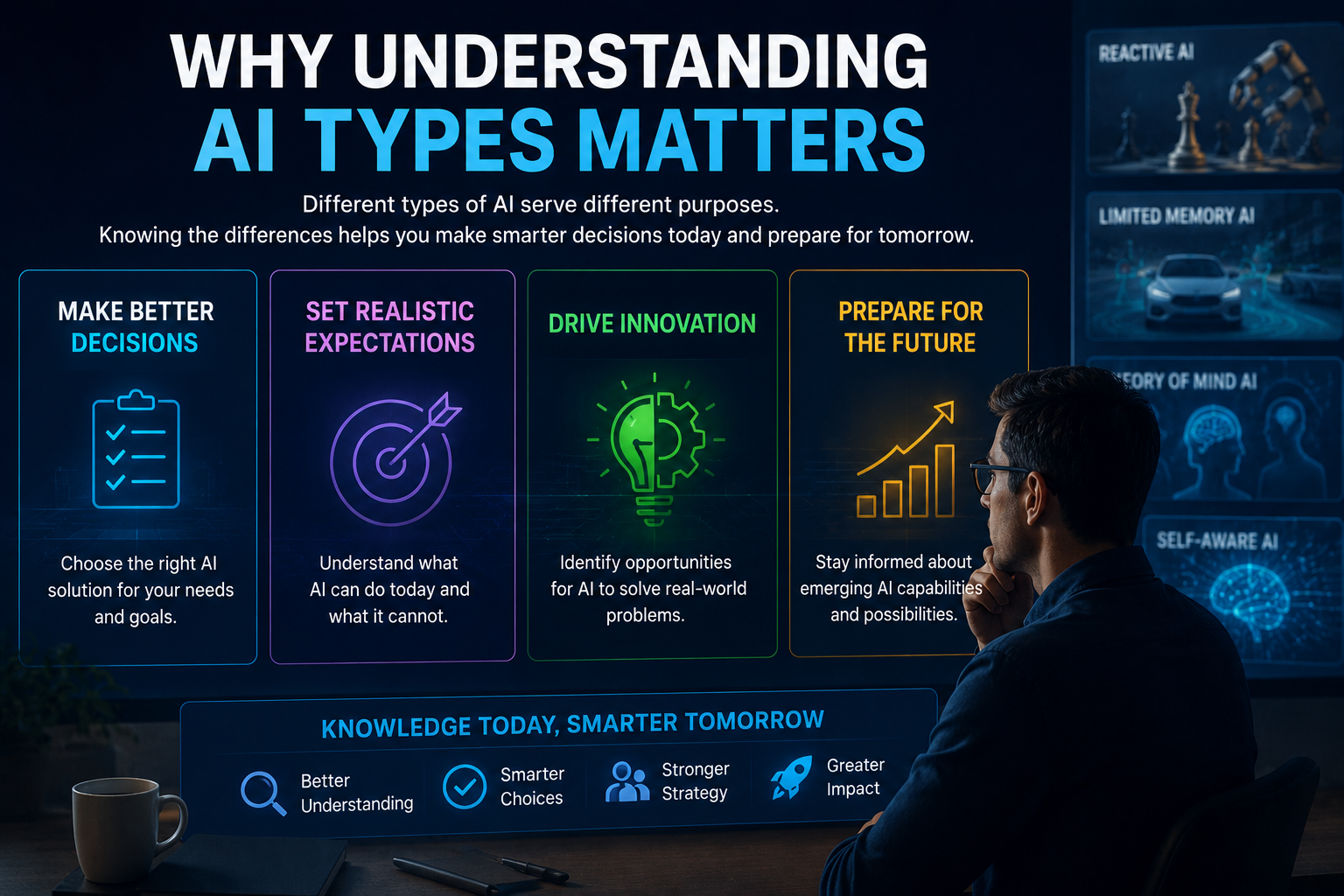
Knowing the different types of AI helps you understand what modern technology can—and cannot—do.
For example:
- It helps separate real AI capabilities from science fiction.
- It makes AI news easier to understand.
- It helps businesses choose the right AI tools.
- It improves AI literacy for students and professionals.
- It encourages responsible discussions about future AI development.
As AI becomes part of everyday life, understanding these basics will become increasingly valuable.
Final Thoughts
Artificial intelligence is transforming how people work, learn, communicate, and solve problems.
But AI is not one single technology. Understanding the Types of Artificial Intelligence helps explain how different Types of AI systems have different abilities and purposes.
Today, nearly all AI systems—including chatbots, recommendation engines, translation tools, and image generators—are forms of Artificial Narrow Intelligence powered by Limited Memory AI.
The more advanced concepts, such as Theory of Mind AI, Artificial General Intelligence, and Self-Aware AI, remain areas of ongoing research rather than everyday reality.
As AI continues to evolve, learning about these different Types of Artificial Intelligence will help you use AI more effectively and recognize both its current strengths and future possibilities.
Explore the World of AI
Want to understand how artificial intelligence works? Keep exploring AI concepts, technologies, and trends to learn how different types of AI are shaping the future of work, learning, and everyday life.
For more Articles, Visit our page – AI UNPACKED
Official Resources for Further Reading
For the latest features and official documentation, refer to these sources:
- IBM Artificial Intelligence Resources
- IBM AI Types Explained
- Stanford Artificial Intelligence Laboratory (SAIL)
- MIT Computer Science and Artificial Intelligence Laboratory (CSAIL)
- Google DeepMind
- OpenAI Research
- National Institute of Standards and Technology (NIST) – Artificial Intelligence Resources
- UNESCO Artificial Intelligence Resources
These sources are suitable for supporting information about AI categories, machine learning, deep learning, AGI, AI research, and responsible artificial intelligence development.
Frequently Asked Questions (FAQs)
What are the four main types of Artificial Intelligence?
The four types of AI based on capability are:
- Reactive Machines
- Limited Memory AI
- Theory of Mind AI
- Self-Aware AI
Only the first two currently exist in practical use.
What type of AI is ChatGPT?
ChatGPT is considered a form of Artificial Narrow Intelligence (ANI). It is also an example of Limited Memory AI, because it can use conversation context within a chat to provide more relevant responses.
Is Artificial General Intelligence real?
No.
Artificial General Intelligence has not been achieved. Researchers continue to study it, but no verified AGI system currently exists.
Is self-aware AI possible?
Scientists do not know.
Self-aware AI remains a theoretical concept, and there is no evidence that today’s AI systems are conscious or self-aware.
Which type of Artificial Intelligence is used today?
Most AI applications available today are Artificial Narrow Intelligence (ANI). Many of these systems also fall into the Limited Memory AI category because they learn from data and use recent information to make decisions.
Key Takeaways
- Artificial intelligence is commonly classified by capability and functionality.
- The four capability-based types are Reactive Machines, Limited Memory AI, Theory of Mind AI, and Self-Aware AI.
- Only Reactive Machines and Limited Memory AI are used in practical applications today.
- Artificial Narrow Intelligence (ANI) powers today’s AI tools.
- Artificial General Intelligence (AGI) and Artificial Superintelligence (ASI) have not been achieved.
- Understanding AI types helps you make informed decisions about AI technologies and better understand developments in the field.