History of Artificial Intelligence: From a Simple Idea to the AI Revolution
Meta Title: History of Artificial Intelligence: Timeline From 1950 to 2026
Meta Description: Discover the complete history of artificial intelligence, from Alan Turing and the Dartmouth Conference to ChatGPT and modern AI. Learn how AI evolved step by step.
Artificial intelligence (AI) is everywhere today. People use AI to write emails, create images, answer questions, translate languages, and even help doctors detect diseases. Businesses use AI to improve customer service, schools use it for personalized learning, and developers use it to build smarter software.
But AI didn’t appear overnight.
The history of artificial intelligence is a story that began long before ChatGPT, Google Gemini, or self-driving cars. It started with a simple question:
Can a machine think like a human?
That question inspired scientists, mathematicians, and computer engineers to spend decades building smarter machines. Along the way, AI experienced exciting breakthroughs, disappointing failures, and incredible comebacks.
Today, AI has become one of the fastest-growing technologies in the world, powering everything from search engines and recommendation systems to robots and generative AI tools.
In this guide, you’ll learn the complete history of AI in simple language, making it easy for beginners—and even a 10-year-old—to understand.
What Is Artificial Intelligence?
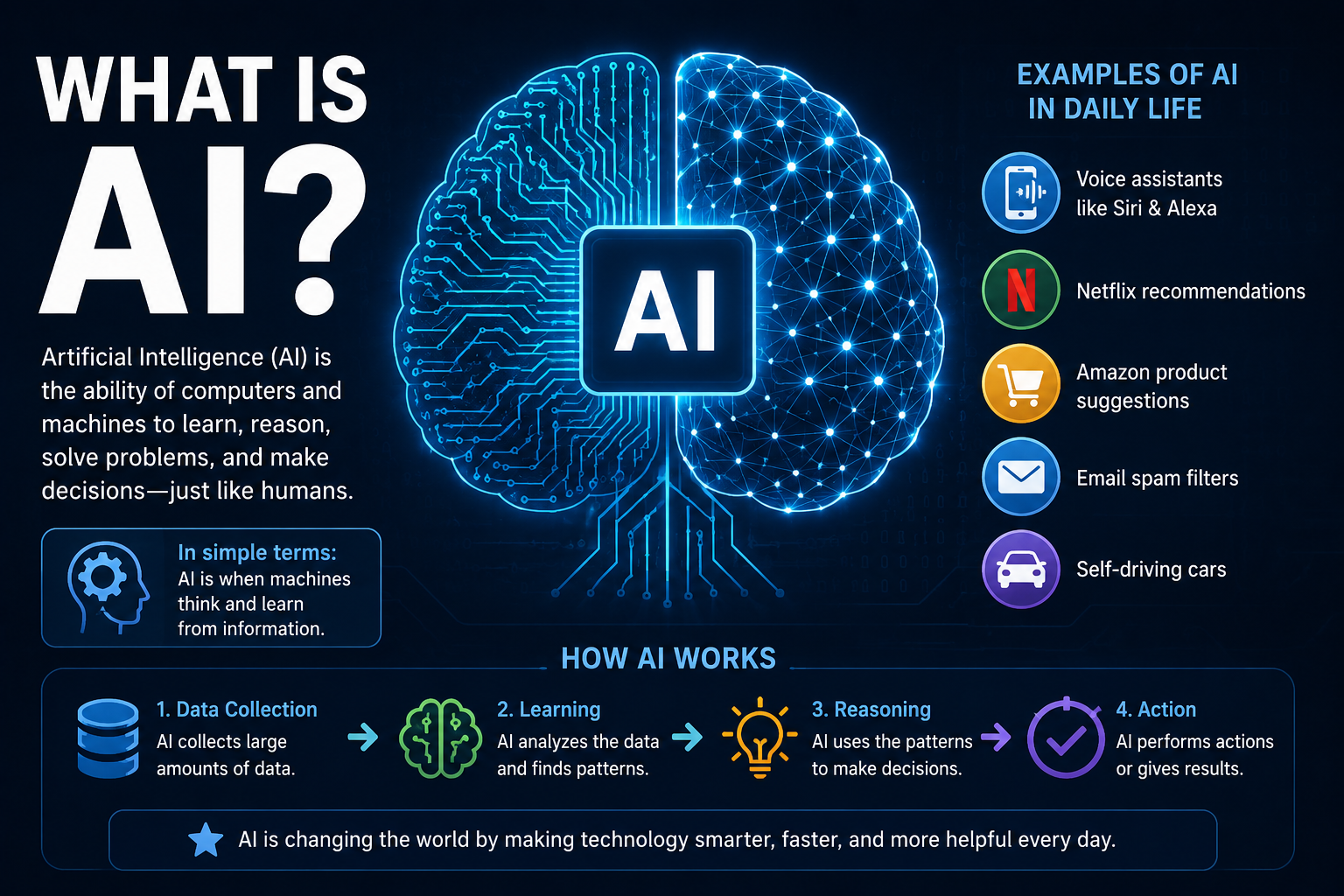
Artificial intelligence is the ability of a computer or machine to perform tasks that normally require human intelligence.
These tasks include:
- Learning from information
- Solving problems
- Recognizing images
- Understanding language
- Making decisions
- Creating text, music, videos, and images
Instead of following only fixed instructions, many AI systems learn from data and improve over time.
Modern AI powers tools like ChatGPT, Microsoft Copilot, Google Gemini, Claude, Perplexity AI, Midjourney, and many other AI assistants.
But reaching this point took more than 70 years of research.
Before Computers: The Dream of Intelligent Machines
Long before computers existed, people imagined machines that could think.
Ancient Greek stories talked about mechanical servants created by the gods. During the Middle Ages, inventors built simple mechanical devices that could perform small tasks automatically.
By the 1700s and 1800s, engineers had created clocks, calculators, and machines capable of performing repetitive work.
Although these weren’t intelligent, they showed that machines could automate human tasks.
The real breakthrough came when scientists began wondering whether machines could make decisions instead of simply following instructions.
That idea laid the foundation for artificial intelligence.
The Birth of Modern Computing
Artificial intelligence would never have existed without computers.
During World War II, computers became powerful enough to solve mathematical problems much faster than humans.
One of the most influential people during this period was British mathematician Alan Turing.
Many people call him the father of modern computer science because his ideas helped shape how computers work today.
Turing believed that if a computer could process information correctly, it might someday imitate human thinking.
At the time, this sounded impossible.
Today, it sounds surprisingly familiar.
Alan Turing and the Famous Turing Test (1950)
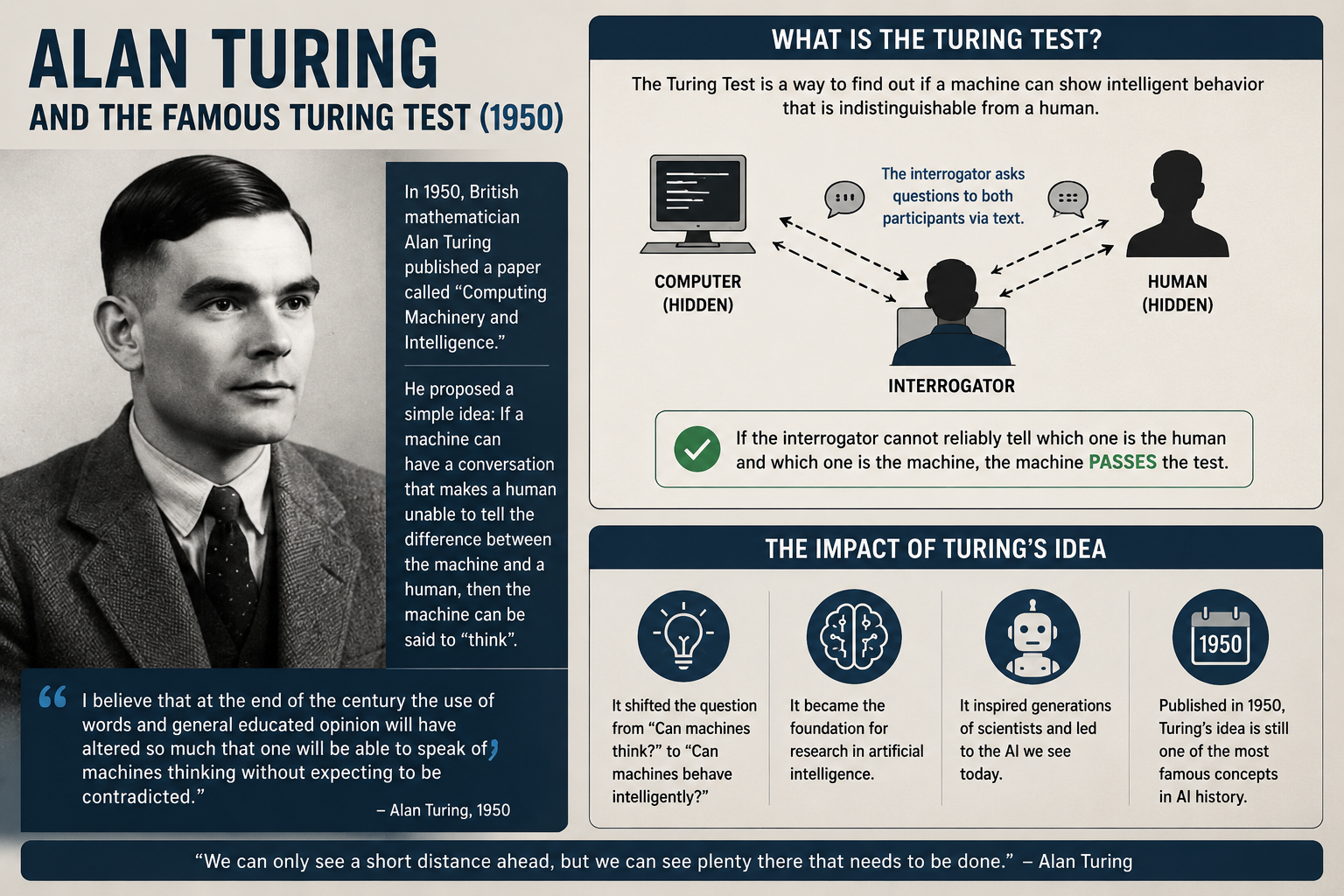
In 1950, Alan Turing published an important paper titled “Computing Machinery and Intelligence.”
Instead of asking:
“Can machines think?”
he asked a different question:
“Can a machine behave so intelligently that a person cannot tell whether they’re talking to a human or a computer?”
To answer this, he proposed the Turing Test.
Here’s how it works:
- A person chats with two hidden participants.
- One participant is human.
- The other is a computer.
- If the judge cannot reliably tell which is which, the computer passes the test.
Although modern researchers debate whether the Turing Test is still the best way to measure AI, it became one of the most famous ideas in artificial intelligence history.
Even today, discussions about conversational AI often mention Alan Turing’s work.
The Dartmouth Conference (1956): The Official Birth of AI
The year 1956 is widely considered the official beginning of artificial intelligence.
That summer, a group of scientists gathered at Dartmouth College in New Hampshire.
The workshop was organized by computer scientist John McCarthy.
During this meeting, McCarthy introduced the term:
Artificial Intelligence
This was the first time AI became its own scientific field.
The researchers believed that if they studied intelligence carefully enough, machines would eventually be able to:
- Learn
- Solve problems
- Understand language
- Improve themselves
Many of them thought these goals could be achieved within a few decades.
They underestimated just how difficult intelligence really is.
Still, the Dartmouth Conference marked the true beginning of AI research.
The 1950s and 1960s: AI’s First Golden Age
After the Dartmouth Conference, excitement spread quickly.
Universities across the United States began investing in AI research.
Government agencies also funded many AI projects because they believed intelligent computers could help with science, defense, and technology.
Researchers developed programs that could:
- Solve algebra problems
- Play simple games
- Prove mathematical theorems
- Complete logical puzzles
These early successes made people believe that fully intelligent machines were just around the corner.
But the reality was much different.
Early AI Programs
Some of the first AI systems amazed researchers.
One program solved mathematical proofs.
Another played checkers better each time it practiced.
These programs couldn’t think like humans, but they showed that computers could perform tasks once believed to require intelligence.
This was an enormous achievement during the 1950s.
The Perceptron (1957)
In 1957, psychologist Frank Rosenblatt introduced the Perceptron.
The Perceptron was one of the earliest neural network models.
It was inspired by how neurons work inside the human brain.
Although it was very simple compared to today’s AI systems, it could recognize basic patterns.
Many people believed neural networks would soon lead to human-level intelligence.
That prediction turned out to be far too optimistic.
The First AI Winter (1970s)
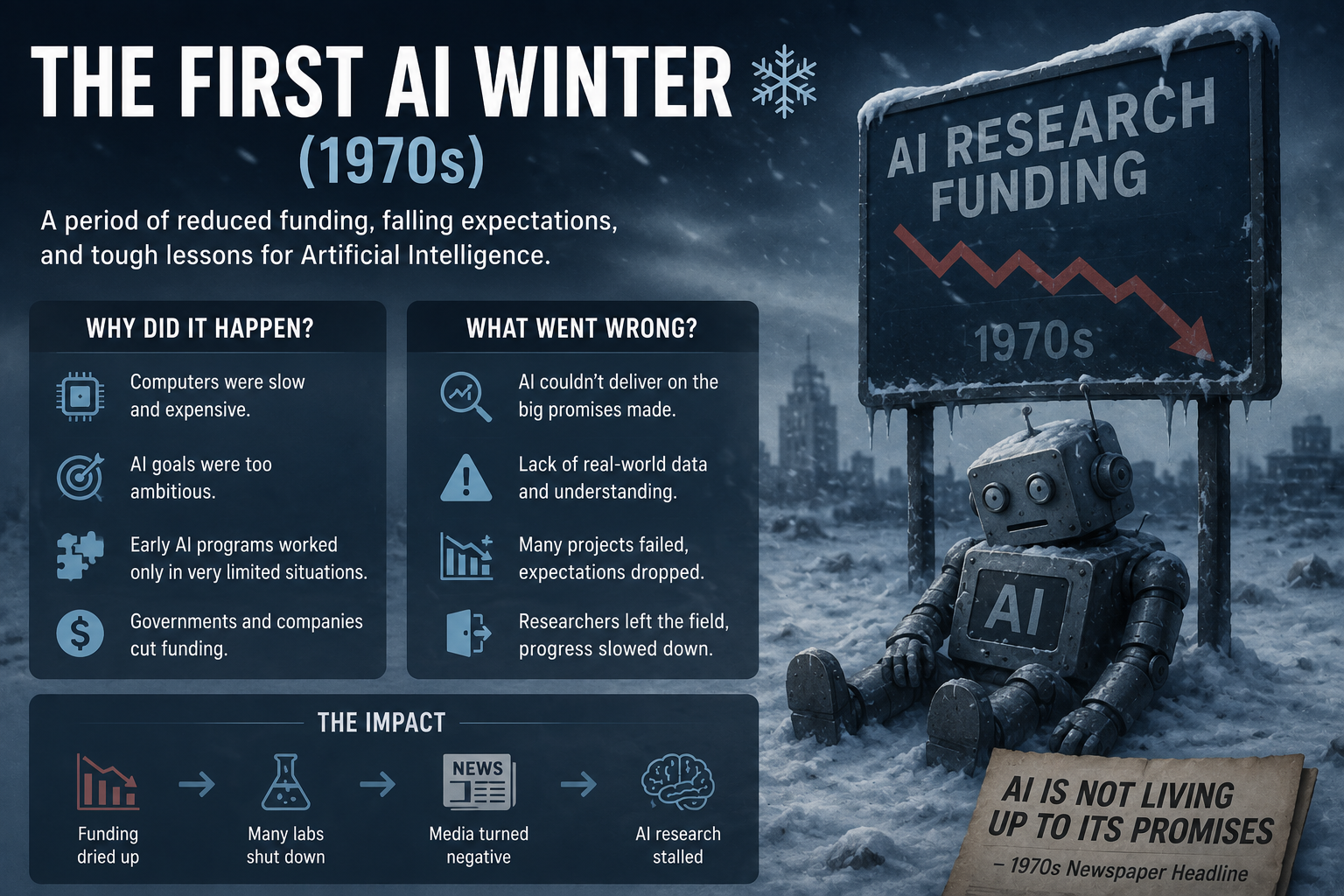
By the late 1960s, researchers realized AI was much harder than expected.
Computers were still very slow.
Memory was limited.
There wasn’t enough digital data to train intelligent systems.
Many AI programs only worked in carefully controlled situations.
If anything changed, they often failed completely.
Governments and investors began losing confidence.
Funding for AI research dropped sharply.
This difficult period became known as the AI Winter.
Why Was It Called an AI Winter?
The term “AI Winter” describes a time when excitement about AI cooled down.
Research continued, but with much smaller budgets.
Many projects ended because they failed to deliver what researchers had promised.
People realized that building intelligence wasn’t simply about writing more computer code.
The human brain is incredibly complex.
Teaching a computer to understand the real world turned out to be one of the hardest challenges in science.
Lessons Learned During the AI Winter
Although the AI Winter slowed progress, it wasn’t a complete failure.
Researchers learned valuable lessons that still influence AI today.
They discovered that:
- Computers needed much more processing power.
- Better algorithms were necessary.
- Large datasets were essential.
- Intelligence involves learning, not just following rules.
- Human language is much more complicated than expected.
These lessons became the foundation for the next generation of AI research.
Instead of giving up, scientists changed their approach.
That decision would eventually lead to one of the greatest technology revolutions in history.
The Rise of Expert Systems (1980s)
After the first AI Winter, researchers took a different approach. Instead of trying to build machines that could think about everything, they focused on creating programs that were experts in one specific area.
These programs became known as expert systems.
An expert system uses a large collection of rules and facts provided by human experts. When someone asks a question, the system searches its knowledge base and suggests the best answer.
For example, an expert system designed for healthcare could help doctors identify possible diseases based on a patient’s symptoms. Another expert system could help engineers troubleshoot equipment or assist banks in making lending decisions.
Expert systems became popular because they worked well for tasks with clear rules. During the 1980s, thousands of companies invested in them to improve productivity and reduce costs.
However, they had one major weakness.
Every new rule had to be written by humans. If the world changed or the system faced a situation it had never seen before, it often failed.
Researchers realized they needed computers that could learn on their own instead of relying only on human-written rules.
The Second AI Winter
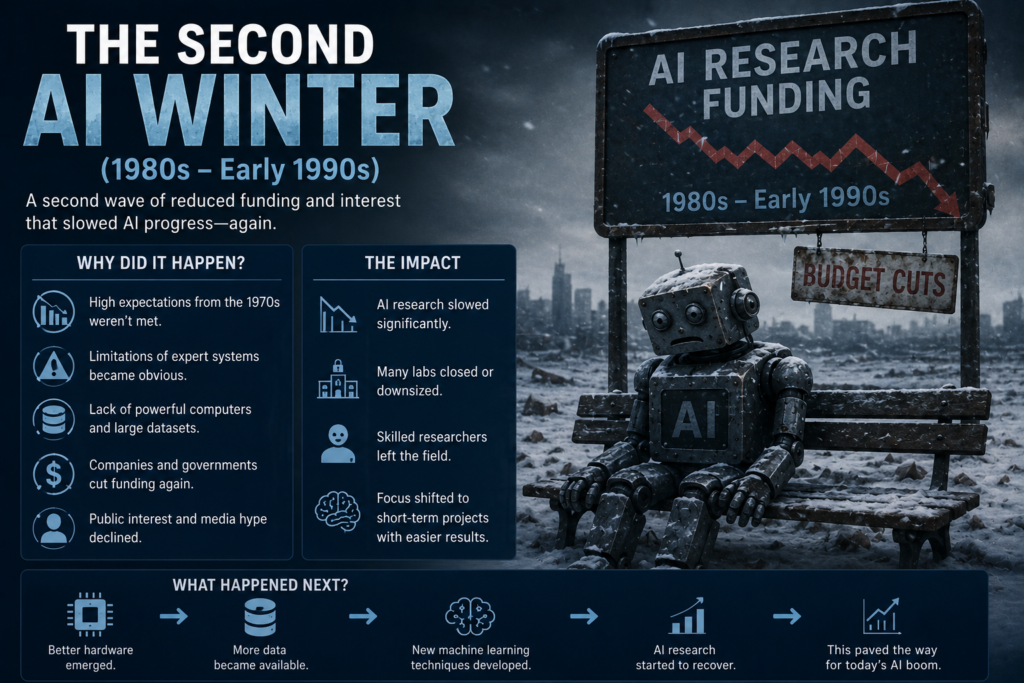
By the late 1980s and early 1990s, enthusiasm cooled once again.
Expert systems were expensive to build and difficult to maintain. Many companies spent millions of dollars without getting the results they expected.
At the same time, computer hardware still wasn’t powerful enough to support more advanced AI techniques.
As investment declined, AI entered another difficult period known as the Second AI Winter.
Although public interest faded, researchers continued working quietly in universities and research labs. Their work would eventually change AI forever.
The Machine Learning Revolution
Instead of teaching computers every rule, scientists developed a better idea:
Teach computers how to learn from data.
This became known as machine learning.
Machine learning allows computers to recognize patterns by studying thousands—or even millions—of examples.
For instance:
- An email service can learn to detect spam by analyzing millions of emails.
- A streaming platform can recommend movies based on what users watch.
- A shopping website can suggest products based on previous purchases.
Unlike expert systems, machine learning models improve as they receive more data.
This shift marked one of the biggest turning points in the history of artificial intelligence.
Today, machine learning powers many of the AI tools people use every day.
More Data Changed Everything
The internet transformed AI.
As millions of people started using websites, smartphones, and online services, enormous amounts of digital information became available.
This data included:
- Images
- Videos
- Text
- Audio recordings
- Maps
- Customer reviews
- Search queries
For AI researchers, this was a goldmine.
The more examples an AI system could study, the better it became at recognizing patterns and making predictions.
At the same time, computers became much faster, and graphics processing units (GPUs) made it possible to train complex AI models far more efficiently than before.
These advances prepared the way for the next breakthrough.
Deep Learning Changed AI Forever
Deep learning is a specialized branch of machine learning that uses large artificial neural networks inspired by the human brain.
Unlike earlier AI systems, deep learning models can automatically discover important patterns without being told exactly what to look for.
This allowed AI to achieve remarkable improvements in areas such as:
- Image recognition
- Speech recognition
- Language translation
- Voice assistants
- Medical imaging
- Self-driving technology
Around 2012, deep learning began outperforming older AI methods on many important tasks.
Companies around the world dramatically increased their investment in AI research.
This period marked the beginning of today’s AI boom.
AI Beats Human Champions
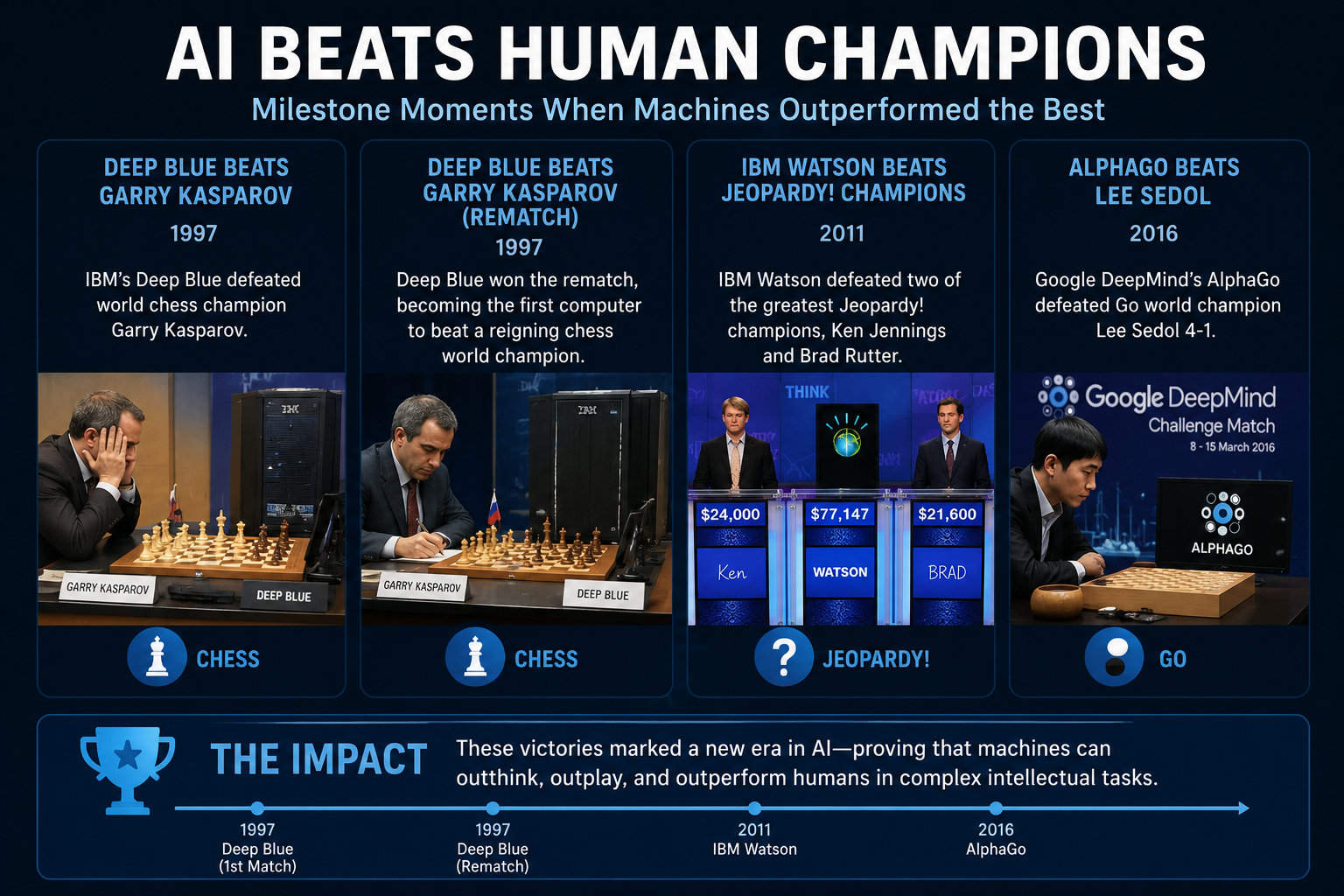
As AI improved, it achieved milestones that once seemed impossible.
One famous example happened in 1997, when IBM’s Deep Blue defeated world chess champion Garry Kasparov in a match.
Years later, AI made another historic achievement.
In 2016, AlphaGo, developed by Google’s DeepMind, defeated world champion Lee Sedol in the ancient strategy game Go.
Go is much more complex than chess because it has far more possible moves.
Many experts believed computers would need decades longer before mastering it.
AlphaGo proved otherwise.
These victories showed that AI had become capable of solving extremely difficult problems using advanced learning techniques.
The Generative AI Revolution
The biggest AI breakthrough for everyday users arrived in the early 2020s.
Instead of simply recognizing information, AI learned how to create new content.
This became known as Generative AI.
Generative AI can produce:
- Articles
- Emails
- Images
- Videos
- Computer code
- Music
- Presentations
- Conversations
Millions of people now use generative AI to work faster, learn new skills, and solve everyday problems.
Businesses use it to improve customer service, marketing, software development, and data analysis.
Generative AI has become one of the fastest-growing technologies in history.
ChatGPT Made AI Mainstream
In late 2022, OpenAI introduced ChatGPT.
Although AI chatbots existed before, ChatGPT made conversational AI accessible to the general public.
People quickly discovered they could use it to:
- Answer questions
- Summarize documents
- Learn new topics
- Write emails
- Brainstorm ideas
- Generate code
- Practice languages
- Create content
Its rapid adoption sparked worldwide interest in AI.
Soon afterward, other companies released powerful AI assistants, leading to rapid competition and innovation.
Today, AI assistants are available on smartphones, computers, web browsers, search engines, and business software used by millions of people.
AI in 2026
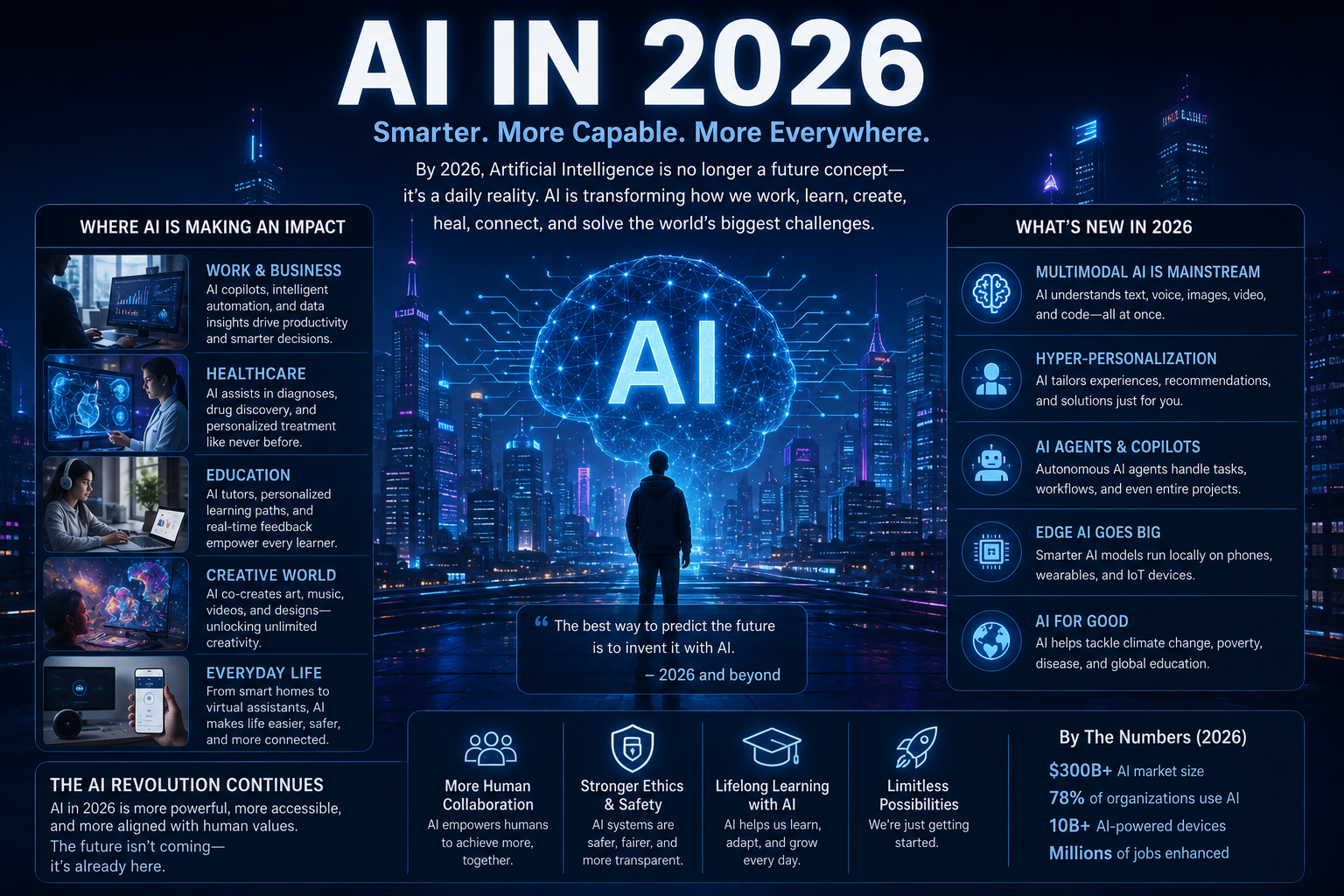
Artificial intelligence continues to evolve at an incredible pace.
Today, AI is helping people across nearly every industry.
Some of the most common uses include:
- Healthcare and medical research
- Education and personalized learning
- Finance and fraud detection
- Manufacturing and robotics
- Customer support
- Software development
- Marketing and advertising
- Scientific research
- Transportation
- Cybersecurity
Modern AI is also becoming better at understanding text, images, audio, and video together, making it more useful than ever before.
However, today’s AI still has limitations.
It can make mistakes, misunderstand questions, or provide inaccurate information. Human oversight remains essential, especially in healthcare, law, finance, and other high-stakes situations.
Researchers continue working toward AI systems that are more reliable, transparent, and helpful.
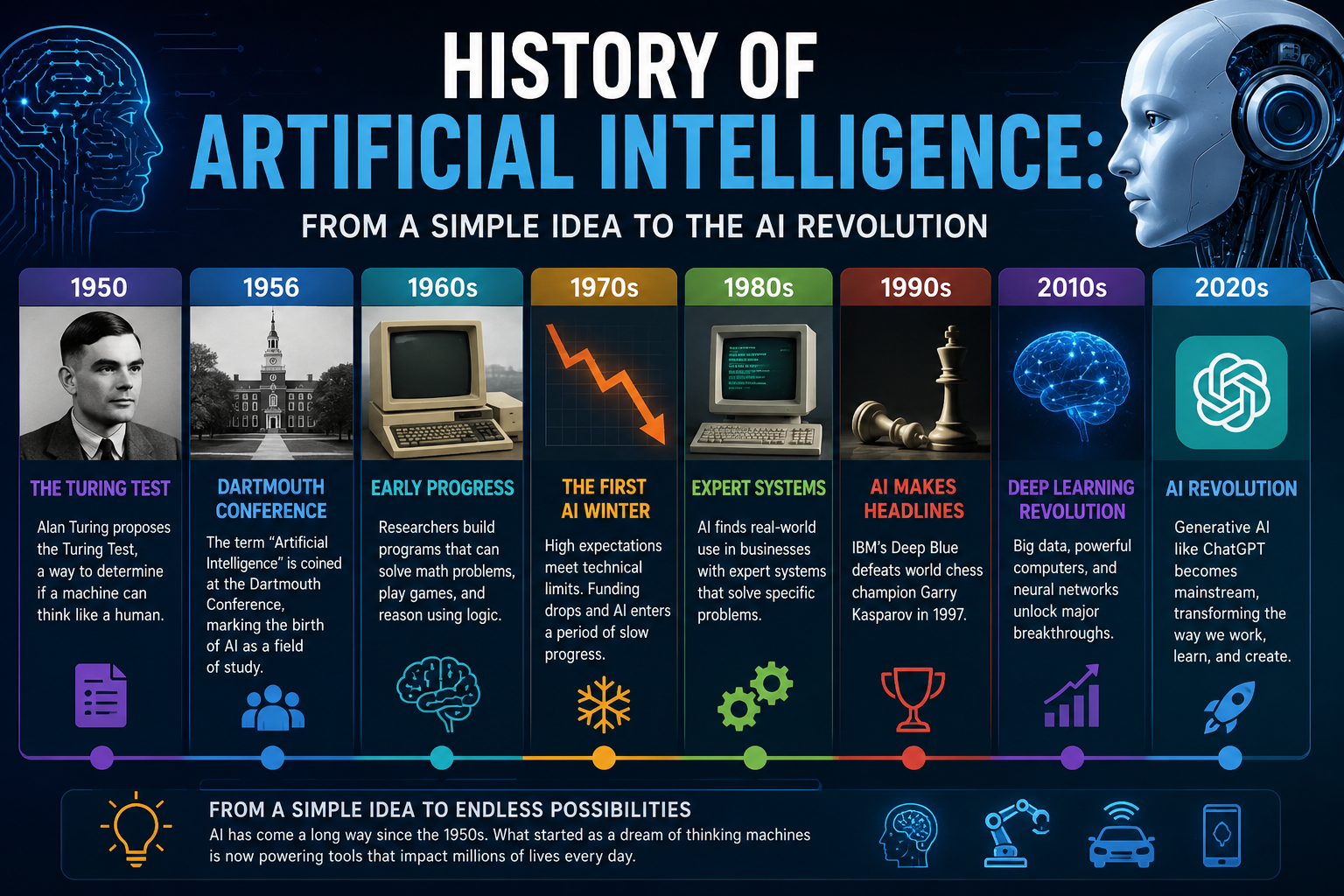
History of Artificial Intelligence Timeline
| Year | Milestone |
|---|---|
| 1950 | Alan Turing proposes the Turing Test. |
| 1956 | Dartmouth Conference officially introduces the term “Artificial Intelligence.” |
| 1957 | Frank Rosenblatt develops the Perceptron. |
| 1970s | First AI Winter begins due to limited computing power and unmet expectations. |
| 1980s | Expert systems become widely used in businesses. |
| Late 1980s–1990s | Second AI Winter slows research and investment. |
| 1997 | IBM Deep Blue defeats chess champion Garry Kasparov. |
| 2012 | Deep learning achieves major breakthroughs in image recognition. |
| 2016 | AlphaGo defeats Go champion Lee Sedol. |
| 2022 | ChatGPT brings generative AI into mainstream use. |
| 2023–2026 | Rapid growth of AI assistants, multimodal AI, and enterprise AI tools. |
Why Does AI History Matter?
Understanding the history of artificial intelligence helps us appreciate how much effort went into today’s technology.
Every breakthrough was built on decades of research, experimentation, and learning from failure.
The story of AI teaches an important lesson:
Progress rarely happens in a straight line.
There were exciting discoveries, disappointing setbacks, and long periods where many people believed AI would never succeed.
Yet each generation of researchers solved new problems and laid the foundation for future innovations.
The AI tools we use today are the result of more than 70 years of continuous improvement.
Final Thoughts
The history of artificial intelligence is a remarkable journey of curiosity, persistence, and innovation.
From Alan Turing’s early ideas to the Dartmouth Conference, from AI winters to deep learning, and from expert systems to ChatGPT, every milestone has shaped the technology we use today.
AI has evolved from a research project into a powerful tool that helps people work, learn, create, and solve problems more efficiently.
While today’s AI is more capable than ever before, its story is still being written. Researchers continue exploring new ideas, improving safety, and expanding what intelligent systems can achieve.
Whether you’re a student, a professional, a business owner, or simply curious about technology, understanding the history of AI provides valuable insight into where this rapidly changing field came from—and where it may go next.
Frequently Asked Questions
Who is considered the father of artificial intelligence?
John McCarthy is widely known as the Father of Artificial Intelligence because he coined the term “Artificial Intelligence” and organized the Dartmouth Conference in 1956.
Who is considered the father of computer science?
Alan Turing is often called the father of modern computer science because of his groundbreaking work on computation and machine intelligence.
When did artificial intelligence begin?
Modern artificial intelligence officially began in 1956 during the Dartmouth Conference, although the ideas behind intelligent machines existed much earlier.
What was the first AI Winter?
The first AI Winter occurred during the 1970s when funding and public interest declined because early AI systems failed to meet expectations.
What caused the AI boom?
Several factors contributed to the AI boom:
- Faster computers
- More digital data
- Improved machine learning algorithms
- Powerful GPUs
- Advances in deep learning
- Generative AI models
Is AI still improving?
Yes. AI continues to improve rapidly, with ongoing research focused on reasoning, multimodal understanding, robotics, healthcare, education, and scientific discovery.